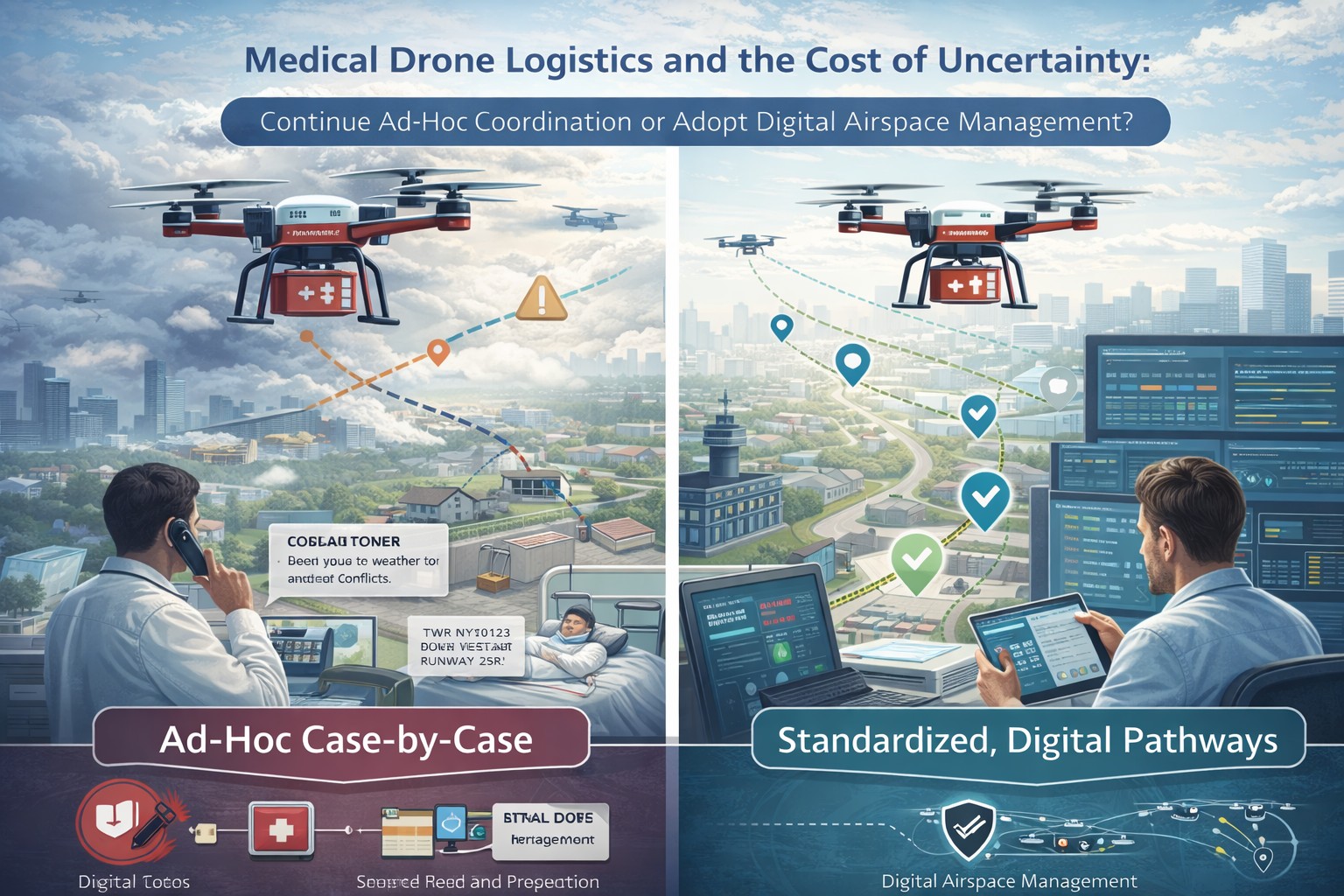
Medical Drone Logistics and the Cost of Uncertainty
Published:
January 9, 2026
Category:
Airspace Integration
Client:
Medical Drone Logistics and the Cost of Uncertainty
Background
Medical drone logistics companies such asMatternet were tasked with transporting time-critical medical supplies, lab samples, blood products, and pharmaceuticals between hospitals and laboratories.
Unlike consumer delivery, failure in this context carried direct clinical consequences. Delays, diversions, or airspace uncertainty were unacceptable.
The Challenge
Medical operators faced a paradox:
They neededpredictable, repeatable flight paths
Yet they operated in shared airspace subject to dynamic constraints
Lacked prioritization for missions that were urgent
Regulators required clear evidence that flights could be conducted safely, consistently, and without interfering with other airspace users, especially near hospitals and urban centers.
The Decision Point
The central question became:
How can a medical logistics operator prove reliability and safety at scale without treating every flight as an exception?
Outcome
By adopting UTM-enabled governance and oversight, medical operators were able to:
Shift from case-by-case approvals to standardized operating envelopes
Establish a regulator-auditable safety assurance
Treat drone routes as dependable logistics links rather than experimental trials
Incorporate prioritization to ensure airspace right-of-way is awarded when necessary This transition allowed medical drone programs to integrate into routine healthcare operations rather than remain peripheral innovations.