As the aviation industry looks beyond conventional uncrewed aircraft toward Advanced Air Mobility (AAM) and Urban Air Mobility (UAM), the scale and complexity of the challenge increases dramatically. Unlike early drone operations, often isolated, low-altitude, and limited in scope, AAM envisions:
High-frequency operations
Cargo and passenger-carrying aircraft
Dense urban environments
Seamless interaction with existing Air Traffic Management (ATM) systems
Operating between non-traditional locations, such as parking lots
Public agencies and industry stakeholders increasingly recognized that aircraft certification alone would be insufficient. The question was not simply how to certify vehicles, but how to manage an ecosystem of increasingly autonomous airspace users safely and at scale.
The Institutional Landscape
Multiple public-sector organizations began exploring this challenge in parallel:
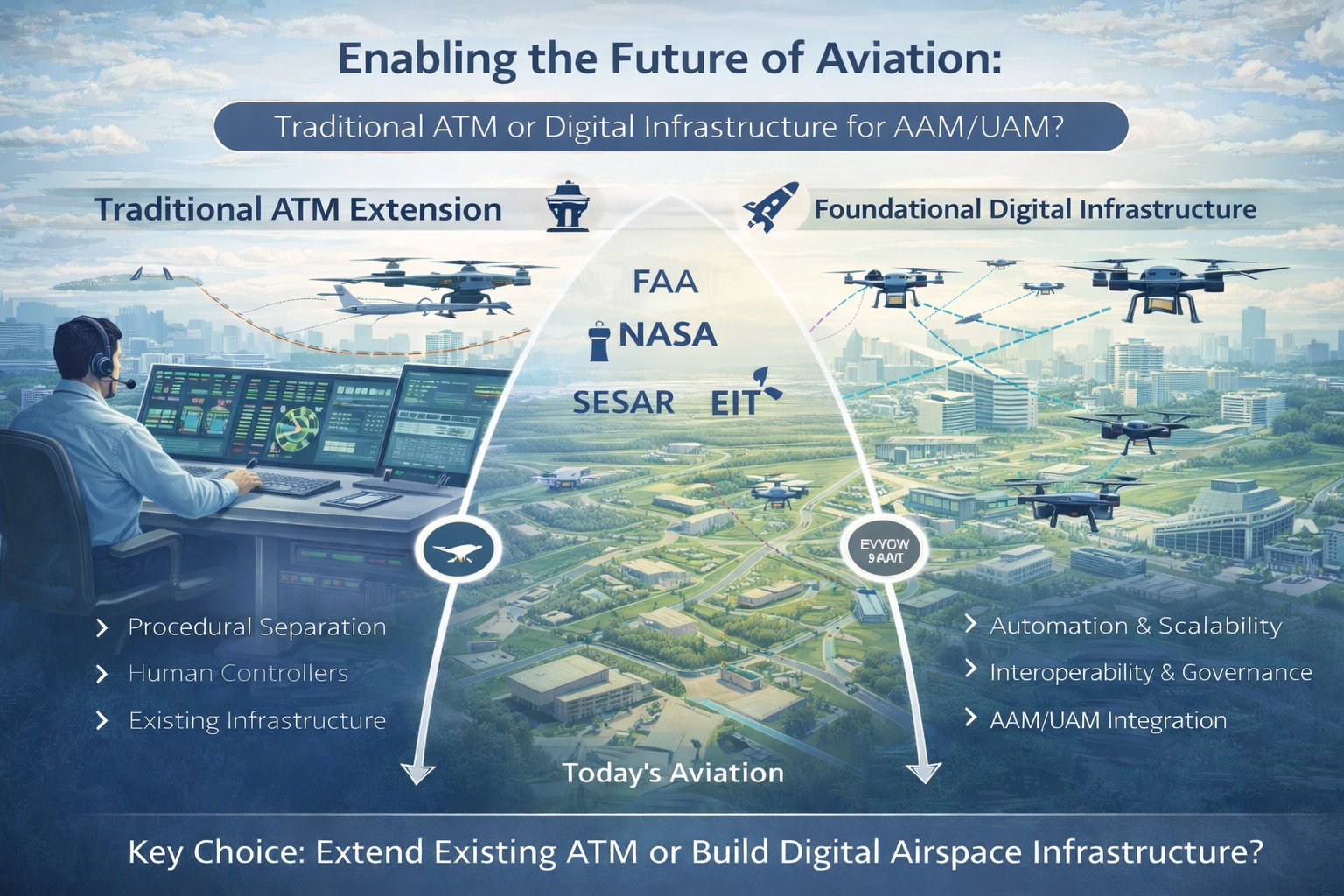
The FAA examined how future rules (including BVLOS and AAM-related frameworks) would rely on digital services rather than procedural separation.
NASA, through its UTM and AAM research programs, investigated how automation, data exchange, and distributed decision-making could support high-density operations.
In Europe, SESAR Joint Undertaking focused on U-space and the integration of drones and future air vehicles into controlled and uncontrolled airspace.
Programs supported by theEuropean Institute of Innovation and Technologyexplored real-world demonstrations linking cities, regulators, and technology providers to AAM/UAM deployment scenarios.
While these efforts varied in scope and geography, they converged on a shared realization: future aviation would be digitally mediated.
The Challenge
The core challenge facing regulators and system architects was structural:
How do you ensure safety, scalability, and interoperability in an airspace where autonomy, not human control, is increasingly the norm?
Traditional ATM systems were designed around:
Human controllers
Voice communications
Centralized decision-making
AAM/UAM concepts, by contrast, assume:
Highly automated decision loops
Machine-to-machine coordination
Distributed operations across many operators
Bridging this gap required more than incremental upgrades; it required a foundational digital layer that could interoperate with both legacy ATM systems and future autonomous platforms.
The Decision Point
Policy-makers and ecosystem leaders faced a critical choice:
Treat AAM/UAM as an extension of existing ATM systems, adapting procedures incrementally, or
Establish anew digital infrastructure layer, complementary to ATM, that could:
Enable automation
Support interoperability
Scale across vehicles, operators, and jurisdictions
Interact with UTM
This decision would shape not only technical architectures but also certification pathways, regulatory oversight models, and international harmonization.
The Role of Digital Airspace Infrastructure
Through collaborative work with agencies such as the FAA, NASA, SESAR, and EIT-supported initiatives, a consensus began to emerge around several principles:
Safety would increasingly be system-based, not pilot-based
Interoperability would be mandatory, not optional
Governance and oversight must be digitally enforceable, not manually supervised
Scalability depends on automation, not staffing
UTM and U-space services, originally developed to support drones, began to be recognized asprecursors to AAM/UAM infrastructurerather than temporary solutions.
Outcome and Implications
Rather than viewing UTM as a niche capability for small drones, regulators and research bodies began positioning it as:
Adigital coordination layer between autonomous aircraft and ATM
A platform for incremental autonomy, rather than a binary leap
A mechanism to support international harmonization across airspace systems
In this framing, UTM was no longer just about managing today’s drone flights, it became acritical building block for the future aviation ecosystem.
Looking Forward
The transition to AAM/UAM will not occur through a single regulatory event or technological breakthrough. Instead, it will be enabled byprogressive operationalization of digital infrastructure, tested first with drones, then extended to more complex vehicles and missions.
The organizations shaping this future increasingly recognize that:
Autonomous aviation cannot scale on trust alone; it requires a digitally governed airspace.