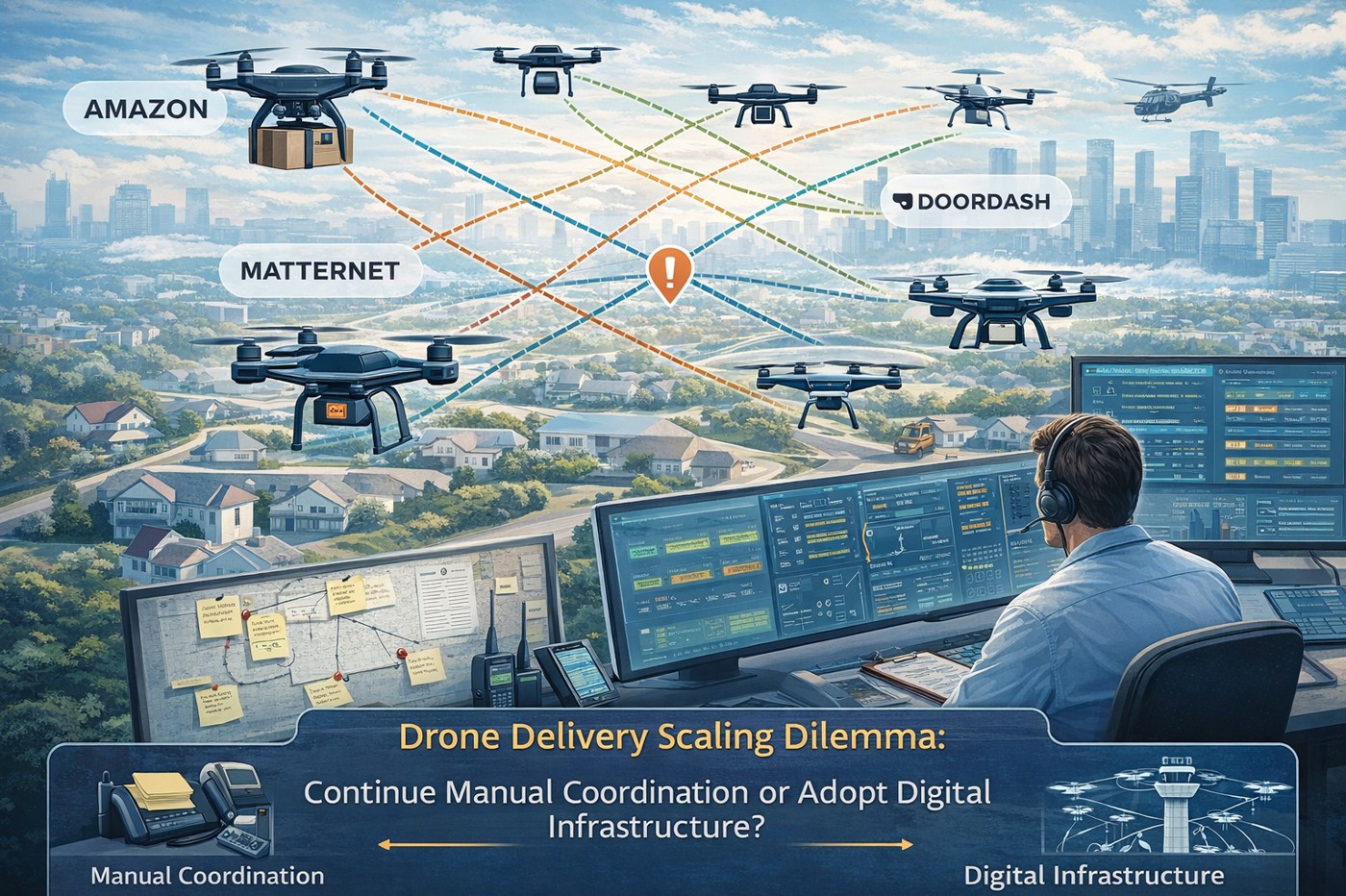
By the early 2020s, large consumer logistics platforms such as Amazon Prime Air, Manna and DoorDash had moved beyond pilot programs into sustained drone delivery operations in multiple U.S. metropolitan areas. The promise was compelling: reduced delivery times, lower last-mile costs, and improved customer experience.
However, success created its own challenges. As flight volumes increased, delivery routes began to overlap not only among themselves but also with crewed aviation and other commercial drone operators. Manual coordination processes, acceptable during early trials, became increasingly brittle.
The Challenge
The core question facing these delivery operators was no longer whether drone delivery could work, buthow to operate at scale without increasing operational risk.
Key challenges included:
Managing concurrent BVLOS flights across dense suburban environments in shared airspace.
Demonstrating predictable safety outcomes to regulators
Reducing reliance on visual observers and ad-hoc coordination
Maintaining schedule reliability as flight density increased
The Decision Point
Leadership teams had to decide whether to:
Continue scaling through incremental human processes, or
Invest in adigital airspace infrastructure layer capable of strategic deconfliction, real-time monitoring, and governance across operators.
Outcome
Operators that adopted UTM services transitioned from route-by-route approvals to repeatable, auditable delivery corridors, enabling daily operations at scale. Drone delivery shifted from a novelty to a logistics subsystem, managed, measured, and governed like other enterprise infrastructure.